
Different Strokes: Dissecting Tactical Shifts Against Fonseca
What did Mensik and Djokovic do differently against Fonseca at Roland Garros?

First Serve
Joao Fonseca delivered on the hype at this year’s Roland Garros. The 19-year-old Brazilian reached his first Grand Slam quarterfinal on the heels of two comebacks from two sets down, including one against Novak Djokovic, and a four-set win over two-time Roland Garros finalist Casper Ruud. While he lost to Jakub Mensik in straight sets in the quarters, Joao showed a spectacular level of heart, talent, and poise over his run that I hope will serve as an inflection point for his still young career.
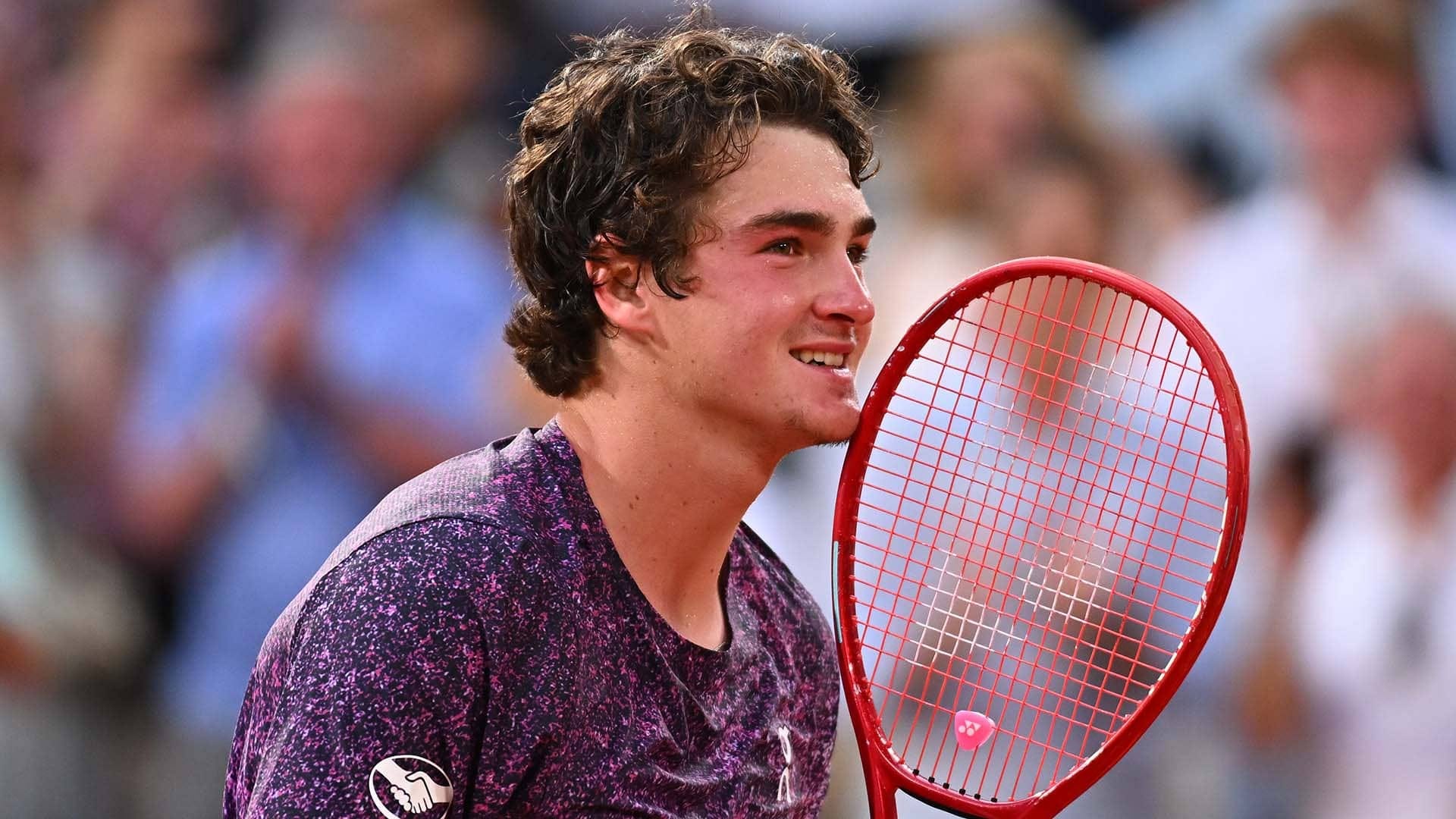
In a surprisingly unpredictable and epically entertaining Roland Garros, Fonseca’s success remains my biggest takeaway. His fellow next-gen competitor Jakub Mensik advancing to a Grand Slam semifinal is significant, but I can’t say it blindsided me. Mensik may not be at his best on clay courts, that part is a surprise, but he’s shown his potential by beating Djokovic in the 2025 Miami Masters final and taking out Sinner in the Doha quarters in February. Fonseca has a rocket launcher for a forehand, but I’ve been waiting for my lightbulb moment in regards to his ceiling. After witnessing his remarkable wins over Prizmic, Djokovic, and Ruud, I can now check that box and happily jump on the Fonseca bandwagon.
Thanks to the incredible Match Charting Project at Tennis Abstract, I have data from Joao’s R32 win over Djokovic and QF loss to Mensik (shoutout to Zindaras and Stard54 for charting these matches so quickly). My goal in breaking down these matches was to simply follow the data to learn more about Fonseca by analyzing his opponents.
1st Serve Dominance
My first takeaways involved serve differences between Mensik and Djokovic. Mensik quietly puts up impressive numbers on serve, and I hope this Roland Garros run will put some respect on his service game. According to Tennis Abstract, Mensik has a 14.6% ace rate in 2026 leading up to Roland Garros, which puts him at second in the top 50 behind Taylor Fritz. In my opinion, Mensik’s ability to dictate on his first serve was a key separator in his match against Fonseca.
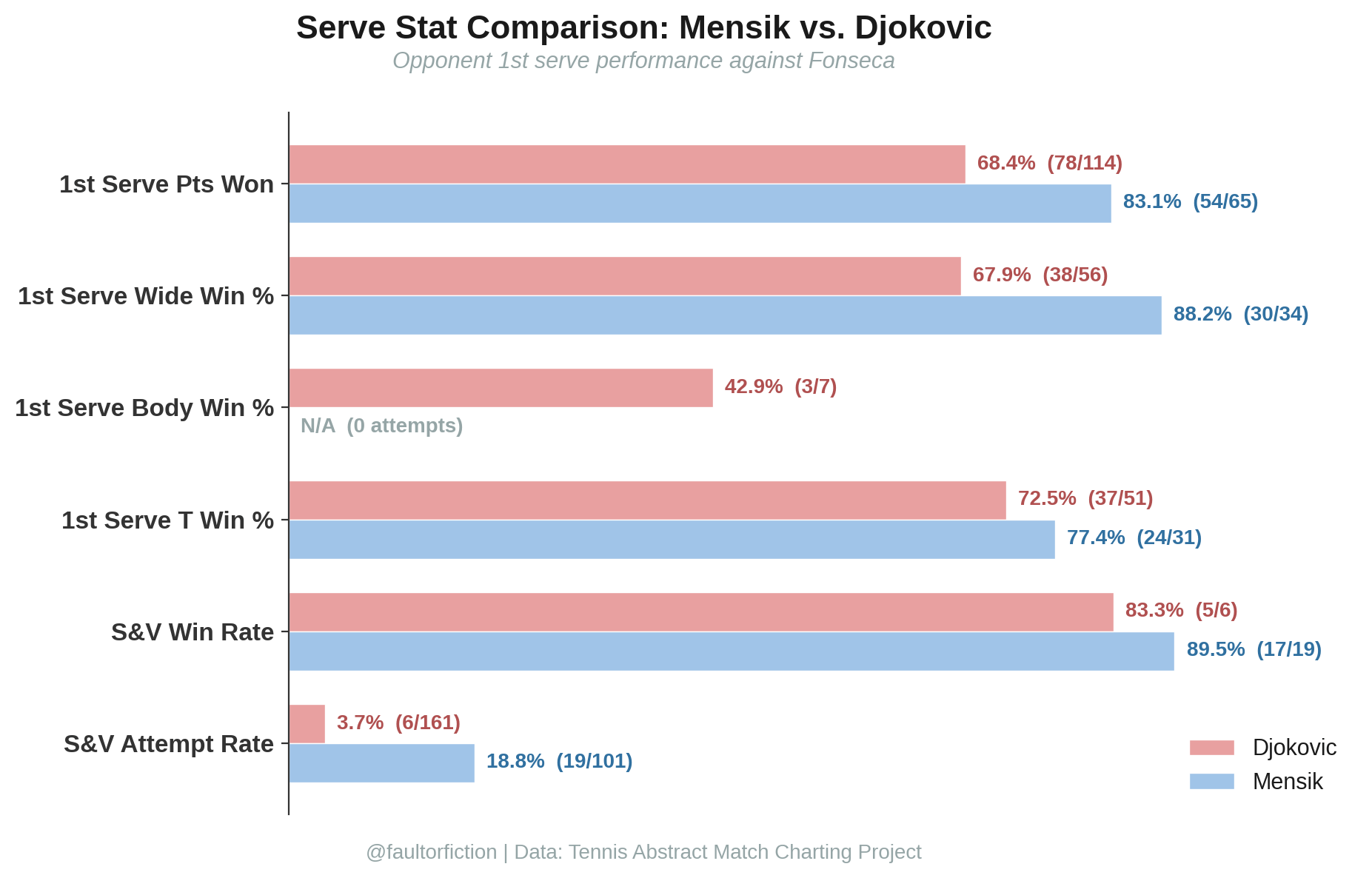
Now, Mensik’s serve is interesting. I’ll point out that he has the largest gap between 1st and 2nd serve win% in the top 50 in 2026 (pre-Roland Garros, Tennis Abstract) at a staggering 30.70%. He won just 33% of his second serve points against Fonseca, but that didn’t seem to stop him as he secured 83% of first serve points. Mensik’s first serve success against Fonseca was a significant shift from Djokovic, who won 68%. Wide first serves were particularly successful for Mensik as his 88% win rate was significantly higher than Djokovic’s 68%. Mensik did not have a single charted first serve to Fonseca’s body, and while Djokovic only had a 6% first serve body rate, it is an interesting data point.
Building off of these observations, Mensik’s first serves often attempted to push Fonseca out of position to set up the serve and volley. According to Tennis Abstract, Mensik has a serve and volley frequency of 9.8% in eight charted matches over the last 52 weeks. Small sample, sure, but it gives us a glimpse at a rough baseline. Against Fonseca, Mensik had a charted serve and volley rate of 18.8%, a clear increase from the charted dataset and an unsurprisingly significant shift from Djokovic’s 3.7%. While Mensik and Djokovic had similar serve and volley success, 89% and 83% win rates respectively, volume is the key differentiator here. I’d want to avoid rallies against Fonseca’s forehand too, and Mensik’s impressively quick movement for his frame combined with his serve strength made serve and volleying a successful tactic.
Directional Shifts
Djokovic played through the middle more than Mensik did, with a charted down the middle rate of 22% compared to 14%. Mensik hit 34% of his forehands inside out, compared to 21% for Djokovic, while Jakub had a backhand down the line rate of 29% compared to Novak’s 17%. Hugh Clarke mentioned how Fonseca uses his backhand down the line to set up his forehand, and I think there is potential overlap here. I have embedded Hugh’s article below.
As usual, Hugh’s observations are sharp and right on the money. Fonseca hit similar percentages of backhand lines in both matches, but I would argue that Mensik avoiding the middle could have worked to disrupt this pattern a bit. The strategy may have been attempted at a similar rate, but the setup conditions were altered. Also, Fonseca can tee off at any time from the forehand wing, so pulling him away from the middle can impact margins when he does launch a forehand.
Another shift I noticed in both the data and watching these matches was Fonseca’s drop shot. First off, I was blown away with Fonseca’s touch against Novak, and he paired the drop shot nicely with his effortless power at the end of the match. Joao won 62% of drop shot points against Djokovic (13/21), but only 25% against Mensik (3/12). Now, these samples are tiny, but the results are worth noting. This is one tactic that worked well against Djokovic but did not have the same effect against Mensik.
The Bigger Picture
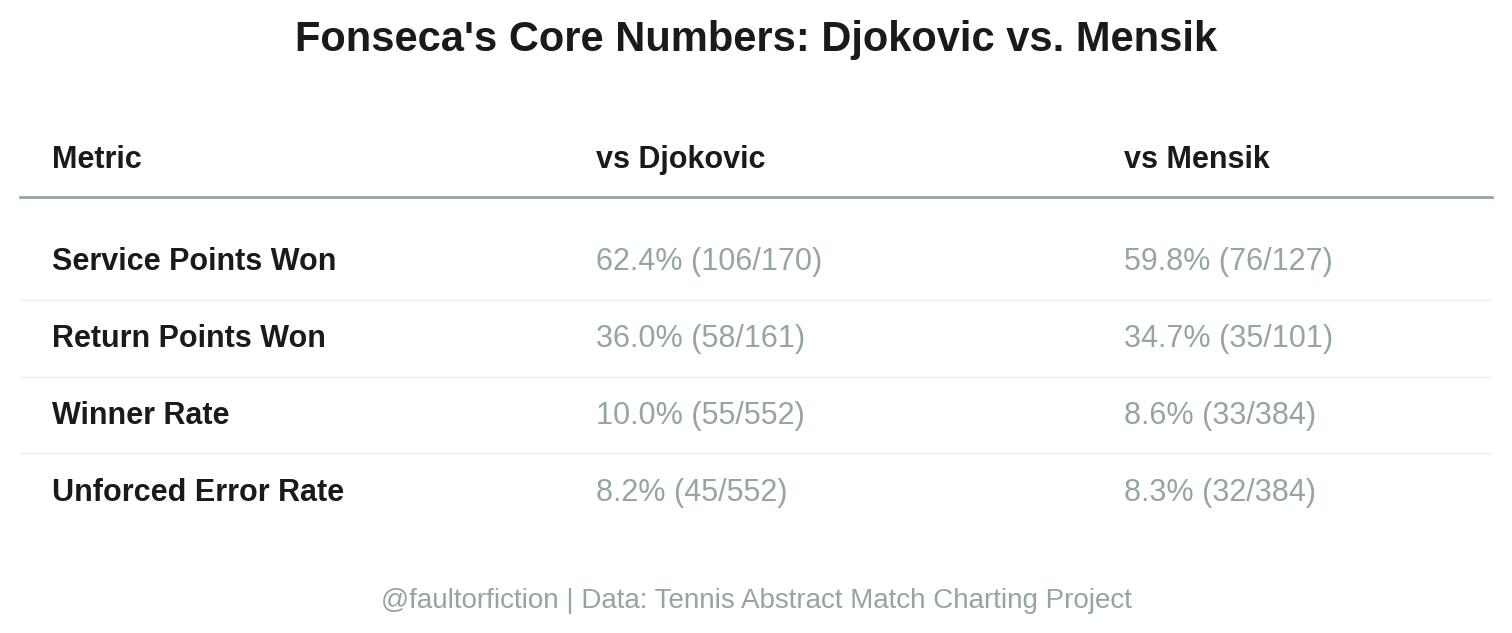
Zooming out, Fonseca’s core numbers are pretty similar across both matches. The table below shows service points won, return points won, winner rates, and unforced error rates in both matches. I don’t think Fonseca played poorly against Mensik, I just think it was a different match than what he was exposed to against Djokovic and likely Ruud. Are there points he will want back and tactics he may wish he didn’t employ? Probably. But that’s tennis. Sometimes your opponent is just better that day, and in my opinion Mensik was.
While I spent this article talking about Fonseca’s opponents, I learned a great deal about his game in the process. As I mentioned at the beginning, I hope that this tournament is an inflection point for his career. He faced adversity against the greatest player of all time on the biggest stage and emerged victorious. Pressure is a privilege, but it can also be crippling, and Fonseca has shown that he is not afraid of the spotlight and can thrive in it. I am looking forward to breaking down more of Fonseca’s matches in the future, especially in the second week of slams.
Join the Conversation
This blog is a work in progress. I’ll show my work, share my mistakes, and encourage critique. I don’t have all the answers, but I love talking tennis and asking questions. Your support helps me inch closer to my dream of working in the tennis industry. If you have questions, or want to nerd out about tennis stats, reach out:
🐦 @faultorfiction
See you courtside. 📊
Mensik definitely capitalised on Fonseca’s often defensive blocked return, and his smash was excellent in that match